
Shopify upsell tactics drive 10 to 30% of ecommerce revenue when placed right. Most stores capture less than 2% because their offers are irrelevant, timed wrong, or shown too often.


Guilhem Teyssier
Founder & CEO
Upsells drive 10 to 30% of ecommerce revenue. That number is real. But the average Shopify store captures maybe 3% of that potential, because most upsell implementations are blunt, mistimed, or just plain annoying.
This guide covers the placements that actually convert, the ones that silently hurt you, and how to build an upsell system that grows your AOV without burning customer trust.
What Upselling Actually Means (and What Most Stores Get Wrong)
Upselling is showing a customer a better or higher-value version of what they are already buying. It is not offering them anything random. It is not stacking five popups on the same page. It is not interrupting the checkout flow with a discount on a product they have never seen.
Most Shopify stores get this wrong in one of three ways. They show irrelevant offers. A customer buying a yoga mat does not want a protein shaker at checkout. They show too many offers, and more than one upsell per placement drops acceptance rates by 40%. They time it wrong, because a popup that fires 2 seconds after a product page loads converts at less than half the rate of one triggered after clicking "Add to Cart."
The rule is simple: one offer, relevant, at the right moment. That is the entire framework.
The Three Upsell Placements That Convert on Shopify
Every upsell placement has a different conversion profile. That profile tells you which to prioritize and what kind of offer to put there.
In-Cart Upsell
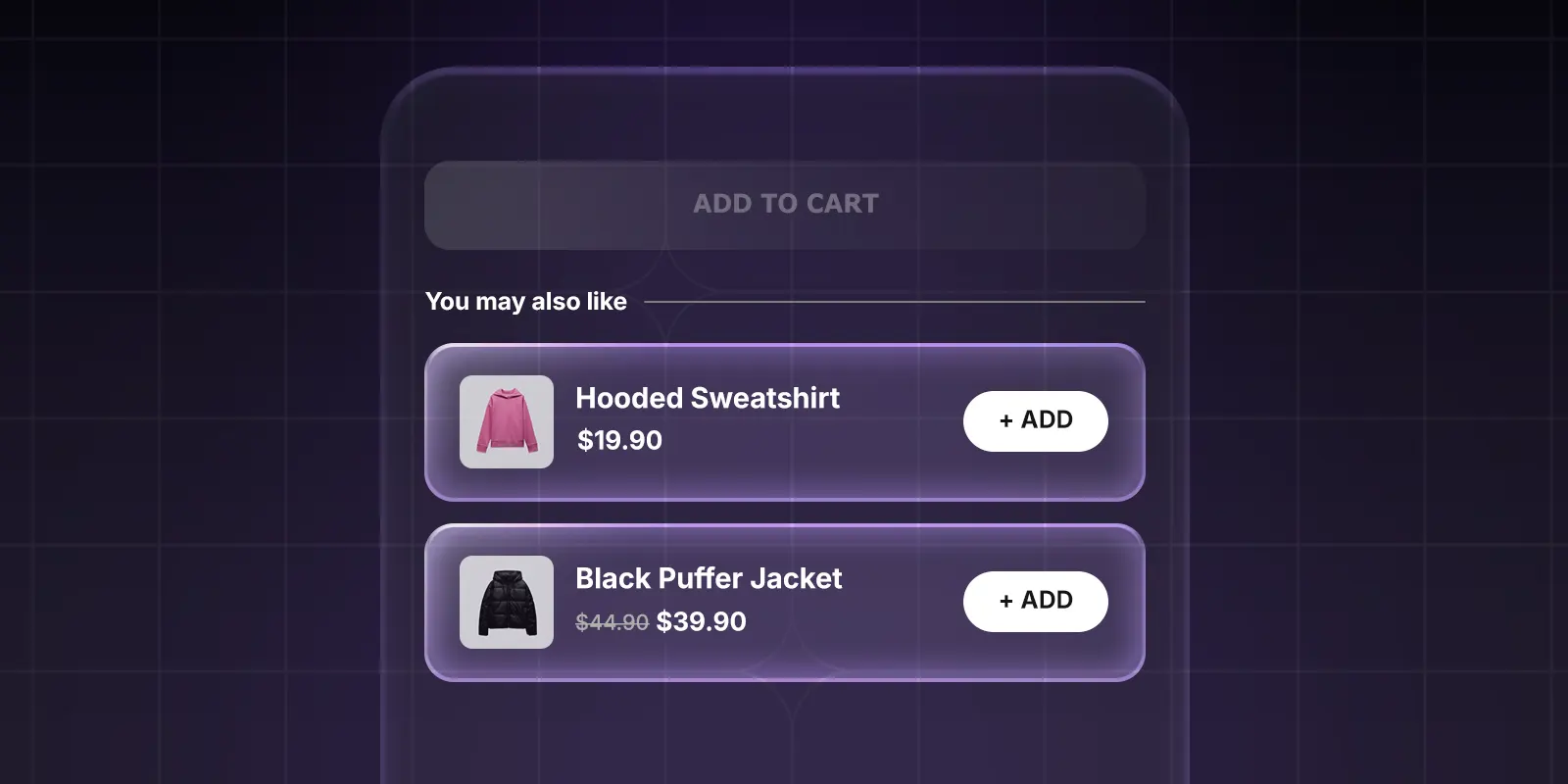
In-cart upsells, shown inside the cart or cart drawer, convert at 5 to 12%. The customer has already committed to buying. They have an open wallet. They have not been asked for their credit card yet. That psychological window is exactly where a well-chosen offer lands.
The best in-cart upsells are direct complements. If the cart contains a coffee grinder, show coffee beans. If it contains running shoes, show insoles or performance socks. The offer should feel like the logical next step, not a sales pitch.
Keep the design lean. One product, one call to action, one clear dismissal option. Skip countdown timers here. Urgency in the cart reads as desperation, and it makes customers second-guess their main purchase.
Post-Purchase Upsell
This is the highest-converting placement most Shopify stores never use. Post-purchase upsells, shown on the thank-you page after payment is complete, convert at 10 to 20%. That beats both in-cart and product page offers.
The reason is psychology. The customer has already bought. The anxiety of spending money is gone. They are in a relief state, slightly excited. A single relevant offer at that moment catches them at the highest willingness-to-spend point in the entire session.
Shopify's native thank-you page extensions let you add these without any checkout modification. The offer should be completable in one click, with no re-entering of payment details. A $15 to $25 add-on converts better here than an $80 product. Price matters more at this step than anywhere else in the funnel.
Product Page Upsell
Product page upsells convert at 3 to 8%. That is the lowest of the three placements. But product pages see the highest traffic volume in any store, so the math still works.
The most effective format is a static "Frequently Bought Together" section below the product description, with individual checkboxes per item. Customers self-select the add-ons they want without feeling pushed. No popup, no interruption, no pressure. Just a clear presentation of what pairs well.
Avoid scroll-triggered or timed popups on product pages. They interrupt the buying evaluation. Customers who are reading product descriptions and suddenly get a popup are more likely to leave than to engage with the offer.
Placement | Conversion Rate | Best Offer Type | Max Offers to Show |
|---|---|---|---|
Product page | 3 to 8% | Frequently bought together (static) | 2 to 3 options |
In-cart / cart drawer | 5 to 12% | Direct complement product | 1 offer |
Post-purchase (thank-you page) | 10 to 20% | Low-price add-on, one-click purchase | 1 offer |
What Makes an Upsell Offer Actually Convert
Placement is half the equation. The offer itself determines the rest. There are three variables that separate offers that convert from ones that get ignored: relevance, price ratio, and clarity.
Relevance. The upsell must connect directly to what is in the cart. Not tangentially related. Directly connected. The test: would a knowledgeable salesperson in a physical store make this recommendation without it feeling forced? If the answer is no, do not show the offer.
Price ratio. The upsell item should be priced at 25 to 50% of the cart value, maximum. If the cart is $60, the upsell should be $15 to $30. Higher than that and psychological resistance kicks in. Lower, and customers scroll past without registering the offer at all.
Clarity. Two sentences maximum. What is it, and why does it pair with what is already in the cart. No feature lists. No brand story. Just one clear reason this makes sense right now.
When all three variables are correct, upsell acceptance rates land in the top benchmarks: 8 to 12% in-cart, 15 to 20% post-purchase. When even one variable is off, acceptance drops below 3% and customers start sensing something is off about the shopping experience.
Writing Upsell Copy That Works
Most Shopify stores pull their upsell copy from product descriptions. That is a mistake. Product descriptions are written to sell a standalone product to a cold visitor. Upsell copy is written for someone who already said yes to something related.
The formula is a benefit bridge, not a feature list. State how the upsell completes or enhances the thing they just added. "Most people who buy this grab the travel case too, so they do not have to worry about it on the road." That is a different conversation than a product spec sheet.
Specificity converts. "Protects your purchase in transit" performs worse than "Waterproof case, fits this exact model, ships with the same order." The second version removes three objections in one sentence. Not a summary. A solution.
Social proof works especially well in upsell copy. "Added by 34% of customers who buy this" reads as consensus, not pressure. If your platform surfaces real adoption data, use it here. Customers read it as a quiet signal that they are not the only one who thought of this.
Keep the headline under 8 words. Keep the body under 30 words. Keep the CTA to 3 words or fewer. "Add to order." "Include this." Brevity is not laziness. It is respect for the fact that the customer is mid-purchase and scanning, not reading.
The Upsells That Kill Conversions
Some upsell implementations actively hurt revenue. Not neutral. Negative.
Exit-intent popups mid-checkout are the worst offender. They interrupt a customer who is about to pay. The cognitive friction introduced at that moment costs more in lost purchases than any upsell could recover. Research on checkout drop-off consistently shows that unexpected interruptions at the payment stage increase abandonment by 8 to 14%.
Auto-added items are a close second. Pre-ticking a checkbox or silently adding a product to the cart is deceptive. Customers who notice it leave immediately. Customers who miss it and see it on their invoice file disputes and leave negative reviews. This is not a conversion strategy. It is a trust destroyer.
Irrelevant recommendations hurt more than no recommendation at all. A customer who sees a random product at checkout does not just ignore it. They become skeptical of the entire store experience. That skepticism adds friction to completing the original purchase. You do not just lose the upsell. You risk losing the main sale.
The rule: if you are not 90% confident the offer is directly relevant, do not show it.
Free Shipping as an Upsell Trigger
Free shipping thresholds are one of the most effective and least used upsell mechanisms in Shopify. Set your threshold 15 to 20% above your current average order value and you create natural pull toward adding more products, without showing a single recommendation popup.
If your AOV is $72, set the threshold at $85. Show a progress bar in the cart tracking how far the customer is from free shipping. This single change typically lifts AOV by 12 to 18%. Customers self-motivate to spend more. No pushy offer required.
Pair this with a curated suggestions section in the cart, filtered to show only products under $20. The shipping bar creates the motivation. The suggestions remove the friction of deciding what to add. That combination, a progress bar plus low-cost suggestion, often outperforms a standalone product upsell in A/B tests.
ConvertX combines a free shipping progress bar with an in-cart upsell section directly inside the cart drawer, so both levers activate simultaneously without stacking separate apps.
How to Stack Upsells Across the Full Session
A full upsell system uses all three placements in sequence. Done right, the customer encounters three different, relevant offers at three different moments. Done wrong, they feel followed around the store.
The key is never showing the same product category twice. If the product page shows a carrying case upsell, the in-cart offer must be something different: an extended warranty, a consumable refill, a size upgrade. The post-purchase offer is then a third distinct category. Each offer should feel like new information, not a repeated ask.
The sequence should escalate in strategic value. Product page offer: small, low-risk add-on. In-cart offer: meaningful complement the customer will genuinely use. Post-purchase offer: something they would regret missing once the order ships.
Shopify stores that run all three placements with relevant offers and correct timing generate 8 to 15% of total revenue from upsells alone. Stores with one haphazard popup generate less than 2%. The gap is not about having more offers. It is about having the right ones in the right order.
"The best upsell does not feel like an upsell. It feels like the store read your mind and suggested the one thing you were going to need anyway."
Measuring Whether Your Upsells Are Working
Most merchants track upsell revenue in isolation. That tells you almost nothing useful. Track these three metrics instead.
Upsell acceptance rate. What percentage of customers shown an upsell add it to the cart. Benchmarks: 4 to 8% for product page offers, 5 to 12% for in-cart, 10 to 20% for post-purchase. Below these numbers means the offer is not relevant enough, or the timing is wrong, or both.
AOV delta. Customers who engage with an upsell should show an AOV 20 to 40% higher than those who do not. If the gap is smaller, your offer price point is too low. If there is no gap at all, the upsell is attracting customers who were already going to spend more, and you are measuring coincidence, not causation.
Cart abandonment delta. If your cart abandonment rate increases after adding upsell offers, something is broken. Upsells should be neutral to abandonment or improve it slightly. A rising abandonment rate after adding upsell offers means you are showing too many, too aggressively, or the wrong products entirely.
Measure all three weekly for the first month after any upsell change. Two weeks of data is not enough to separate signal from noise in conversion metrics.
What to Prioritize if You Are Starting from Zero
Start with a post-purchase upsell. Highest conversion rate (10 to 20%), lowest customer friction, no changes needed to your cart or product pages. Run it for two weeks. Measure acceptance rate before touching anything else.
Add an in-cart upsell second. Once the post-purchase offer converts, add one relevant product inside the cart. One product only. Measure for two weeks before adding anything else to the cart experience.
Add a free shipping threshold and progress bar. Set it 15 to 20% above your current AOV. This produces a bigger AOV lift than most product recommendations, with zero offer fatigue risk.
Add a product page section last. "Frequently bought together" sections require real inventory insight to work well. A poorly matched section does more harm than no section at all, so this step comes last.
Never show more than one upsell per placement. One offer per touchpoint. That is the rule. No exceptions, no overrides for slow sales periods, no "just this once."
Build the system in layers. Measure each layer before adding the next one. That is how you build upsell revenue that compounds month over month without driving your abandonment rate up.
Frequently Asked Questions
What is the difference between upselling and cross-selling on Shopify?
When is the best time to show an upsell on my Shopify store?
How many upsell offers should I show per customer visit on Shopify?